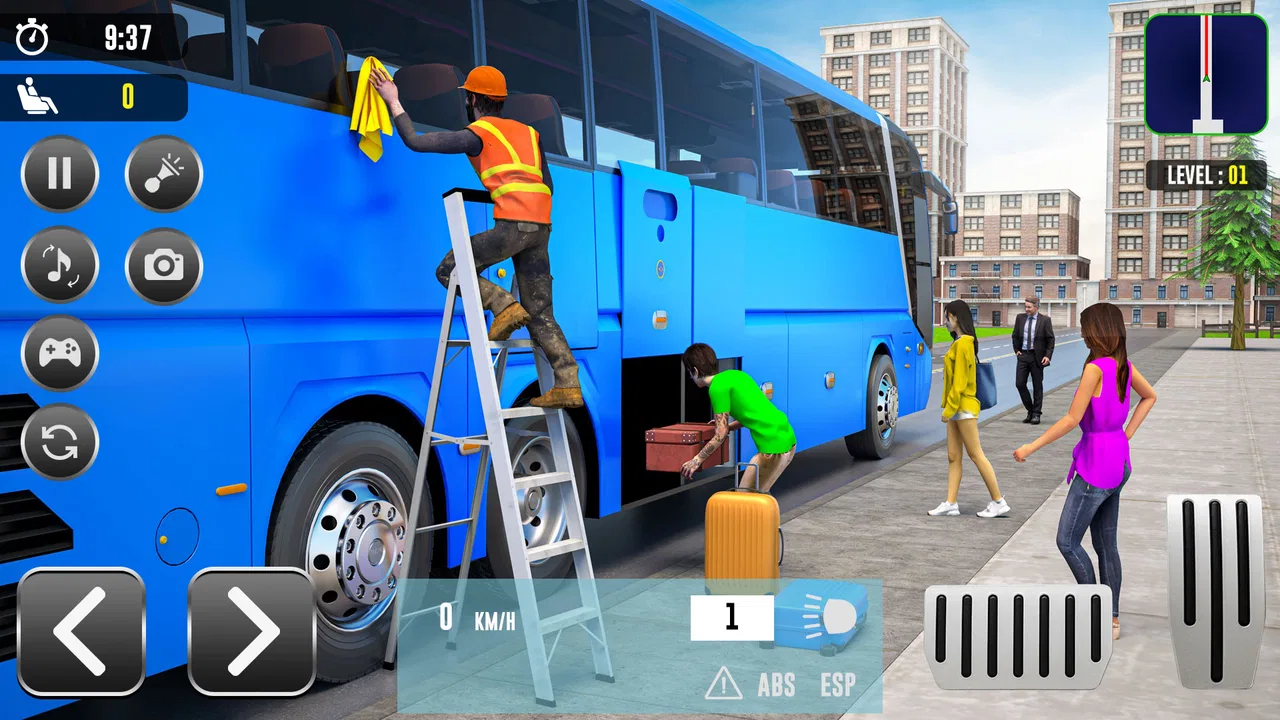
Bus Driving Simulator Bus game
- 4.0
- Rating
- 5.00M
- Installs
- Free
- Price

 Analysis by App-foxy
I approached Bus Driving Simulator Bus as something I could pick up for a short drive rather than as a serious management game. It is a free weather-category app listing from Gaming Stars Inc, but its actual experience is a bus-driving game built around steering, completing levels, and working toward newer buses. That mismatch in classification is worth knowing before you install it, because someone searching for forecasts or rain alerts will not find the tool they expect.
After spending time with it, my impression is fairly clear: this is best for players who enjoy careful vehicle control and short, structured driving challenges. It is not the right choice if you want a deep transport-management simulation, a large open world, or a game that explains every system in detail. The basic appeal is immediate, though. You take control of a bus, learn how it responds, and try to finish each route without turning the drive into a clumsy collision-filled run.
From opening the game to completing a route
When I share a phone or tablet, I find it helps to treat a route as a small turn-taking activity: one person can drive while another watches the next stretch and suggests when to ease off or line up. That keeps the focus on learning the bus rather than competing over unlocks, and it leads naturally to a practical question: what should each person check before taking a turn?
You May Also Like

 Blood Strike: 2.5 Anniversary
Blood Strike’s Loadouts Turn Every Drop Into a Tactical Gamble
A close look at Blood Strike’s custom loadouts: how fast access to signature weapons reshapes its battle royale rhythm, rewards preparation, and narrows the gap between fights.

 Pandora - Music & Podcasts
Pandora’s Music Is Easy to Start, but Harder to Recover
Pandora’s strength is its low-effort path from a seed to a station. Its weak spot is how much confidence it asks you to place in connection, setup, and quiet recovery.

 8 Ball Pool
 Is Built on Rivalries, Rematches, and Routine
A close look at the rivalries, rematches, shared routines, and unanswered safety questions that turn a quick pool match into a persistent mobile community.

 Samsung Music
’s Quiet Strength Is Playing What You Already Own
Its reach comes less from spectacle than from dependable access to a personal library. That simplicity is both the app’s strongest retention engine and its ceiling.

 AccuWeather: Weather Radar
AccuWeather Review: A Quick, Clear Forecast for Everyday Decisions
For everyday plans, the best forecast is the one you can understand quickly. AccuWeather makes rain timing, radar, and local conditions easy to act on, with a few trade-offs.

 Hill Climb Racing
Why Hill Climb Racing Still Turns Crashes Into One More Run
A tiny car, a bumpy hill and one more upgrade: Hill Climb Racing keeps resurfacing because its simple chaos makes every near-miss feel personal.
More From Our News Desk



The starting condition: a simple driving challenge
The first useful question is not whether the graphics look modern or whether the bus collection is large. It is whether you enjoy the feeling of handling a heavy vehicle. A bus is less forgiving than a small car: turns need planning, braking needs restraint, and narrow spaces make even a simple route feel deliberate. That is the mindset I recommend bringing to this game.
The store presents it as a bus simulator, and that description is more helpful than the weather category attached to the listing. The core loop is practical rather than narrative. I enter a level, concentrate on the road and controls, and aim to reach the end cleanly. The fun comes from improving the drive itself, not from following a character story or building a city around the vehicle.
The game is free to download, which makes it easy to test without committing money at the start. It is marked for Everyone, so the presentation is accessible to a broad audience. At the same time, the presence of in-app purchases ranging from $10.99 to $79.99 per item means I would still approach the progression carefully. A free entry point is useful, but it does not automatically mean every desirable upgrade or shortcut will be free.
Step one: learning the controls before chasing progress
My strongest advice is to spend the first few attempts learning the controls instead of treating them as disposable practice. The most common mistake in a bus-driving game is overcorrecting. A small steering movement can become a large change in direction once the vehicle is moving, and hurried adjustments make the bus wander across the road. I found it more productive to make gentle corrections and allow the vehicle to settle before steering again.
Braking deserves the same patience. If I waited until the last moment, the bus felt much harder to place accurately. Slowing earlier gave me more room to line up with the route and reduced the pressure of making a sharp turn immediately afterward. This is a useful workflow for new players: first control speed, then control direction. Trying to solve both problems with frantic inputs usually produces a worse result.
Modern buses are part of the progression appeal, but I would not make unlocking them the only goal. A newer vehicle can feel like a reward, yet the real improvement comes from understanding how the current bus behaves. If you cannot complete a route consistently with the vehicle already available, moving to another bus may not solve the underlying problem. Practice transfers better than impatience.
Step two: reading the route as a sequence of handoffs
Each drive works like a chain of small handoffs. I begin with the control input, pass that decision into the moving bus, then react to the road position and the next turn. The outcome of one section affects the next: entering a corner too quickly leaves less room for correction, while a clean approach makes the following section calmer.
Thinking this way helped me avoid treating the level as one long reaction test. I divided the route mentally into approach, turn, recovery, and exit. On the approach, I focused on speed. During the turn, I used small steering changes. After the turn, I waited for the bus to straighten before preparing for the next instruction. This workflow sounds simple, but it is more reliable than staring only at the immediate obstacle.
There is also a useful trade-off between speed and control. Finishing quickly may feel satisfying, but a rushed run is more likely to lose precision. If the game is frustrating you, try aiming for a clean completion first and worry about faster driving later. That change in objective can make the same level feel less punishing without changing the controls.
Step three: treating the bus like a large object
One non-obvious adjustment is to watch the rear of the bus, not just the front. The front may appear clear while the back still clips a corner or swings toward an obstacle. I learned to begin turns with enough space for the full vehicle, then make only the correction needed to finish the maneuver. This is especially important for players who normally play racing games, where quick steering often helps. Here, quick steering can create a second problem behind the first.
Another practical habit is leaving yourself an exit. When approaching a tight bend, I tried not to position the bus so close to one side that any small error became unrecoverable. A slightly wider approach may look slower, but it gives you a chance to correct. That is a real strength of the game as a casual driving exercise: it rewards awareness more than constant button pressing.
For a short everyday session, this makes the game easy to fit around other activities. Imagine having ten minutes before leaving home or while waiting for an appointment. I would choose a level, use the first attempt to remember the route, and use the next attempt to improve one specific weakness, such as braking too late or turning too sharply. That gives the session a clear outcome instead of turning it into random retries.
Step four: moving from completion to improvement
Once I could finish a route, I changed the goal from survival to consistency. A single successful drive might come from luck, but repeating the same result shows that the controls are becoming familiar. This is where the level structure works well for me. The game provides a defined task, so improvement feels more concrete than simply driving around without a destination.
The progression toward modern buses gives that improvement a visible direction. I like having something to work toward, but I also think players should decide early how much progression matters to them. If you enjoy unlocking vehicles, the game can provide a reason to keep returning. If you only want a relaxed driving toy, the upgrade path may feel like pressure rather than motivation, particularly when purchase options enter the picture.
I would also avoid judging the entire experience by the first few minutes. Vehicle handling often feels awkward before muscle memory develops. Give yourself several careful attempts, but do not force it indefinitely. If the controls still feel unpleasant after you have tried slower steering and earlier braking, that is useful information: this particular style of driving may simply not suit you.
The handoffs between player, vehicle, and progression
The most important handoff is between what I intend to do and what the bus actually does. A good simulator-style game makes me think about the vehicle’s momentum rather than letting me correct everything instantly. That can be satisfying when the response feels predictable. It can also be irritating when I make a small input and the result feels larger than expected.
The next handoff is between driving performance and progression. Completing levels is not only an end point; it is also how I decide whether I am ready to pursue another bus. I prefer to treat new vehicles as a consequence of better driving rather than something I must obtain immediately. This keeps the game focused on the part I came for: handling the route.
Finally, there is a handoff between the game and the player’s phone. The current version is 26.3 and the minimum operating-system requirement is 7.1, so it is positioned to work across a range of older and newer devices. That broad compatibility is convenient, but device age can still affect how comfortable a driving game feels. A smaller screen, less responsive touch input, or an older handset can make precision driving harder even when the game itself is functioning properly.
What the finished drive feels like
The result I get from a successful run is modest but satisfying. I have completed a route, handled the bus more cleanly than before, and gained a clearer sense of where my mistakes came from. This is not the kind of game where every session produces a dramatic story. Its reward is incremental: a better corner, a smoother stop, or a level that no longer feels intimidating.
That makes it a good fit for players who enjoy repetition with a purpose. If you like learning a control scheme and gradually reducing errors, there is enough here to hold attention. The game also suits people who want a vehicle-focused experience without having to learn a complicated economy or manage a large transport network.
Its popularity gives it some useful context. The app has passed five million installs and holds an average rating of 3.9 from around seventeen thousand ratings. I read that as a sign of broad interest rather than universal satisfaction. Many people are willing to try the bus-driving formula, but the rating also suggests that the experience will not please every player, especially those expecting a more polished or deeper simulator.
Where the workflow breaks down
The first friction point is classification. Because the listing sits in the Weather category, a person looking for a weather app could install it by mistake. I would check the store summary carefully before downloading. The short description says “Bus Simulator,” which makes the actual purpose clearer, but the category still creates unnecessary confusion.
The second issue is depth. The game focuses on driving, levels, and bus unlocking, so players who want detailed passenger management, route planning, timetables, fuel decisions, or a living city may find the experience too narrow. In that situation, a dedicated transport-management game or a larger simulation would be a better match. This title is about the act of driving first, not the complete job of operating a bus company.
The third concern is spending pressure. Since the app is free but offers individual purchases between $10.99 and $79.99, I would not let a child use purchase-enabled access without checking the device’s purchase controls first. The Everyone age label describes the content audience, not a guarantee that every family will want the progression economy handled casually. If you prefer games with no optional spending at all, this may be a reason to skip it.
There is also a skill-related breaking point. Players who want instant acceleration, loose steering, and forgiving crashes may find the bus’s size frustrating. Conversely, players seeking a highly realistic professional simulator may find the structure too game-like. The best audience sits between those groups: people who want some care in their driving but still prefer short levels and accessible goals.
How it compares with ordinary alternatives
Compared with a standard racing game, this experience is slower and more deliberate. Racing games usually reward aggressive cornering and rapid reactions, while this one asks me to plan the vehicle’s whole movement. Compared with an open-world driving title, it offers less freedom but gives each drive a clearer purpose. I do not choose it for exploration; I choose it when I want a defined bus-handling task.
Compared with a serious simulation, it is easier to approach but less suitable for someone who wants every professional detail represented. That is not necessarily a flaw. A lighter game can be more enjoyable on a phone because I can start a route quickly and stop after a short session. The trade-off is that experienced simulation fans may finish the available learning curve and want more systems around the driving.
For someone deciding between this and a weather app, the choice is not close: choose a real weather tool for forecasts and alerts, and choose this app only if you want bus-driving gameplay. For someone deciding between this and a racing game, I would choose this one when careful vehicle placement sounds more appealing than speed. For someone deciding between this and a management simulator, I would ask whether steering or planning a whole operation is the main attraction.
Who should install it, and who should skip it
I would recommend it to casual players who like buses, structured levels, and the satisfaction of improving through repetition. It is also a reasonable choice for someone who wants a free first step into driving simulations without immediately committing to a complex management game. The Everyone rating makes the presentation broadly approachable, while the simple premise means you can understand the goal quickly.
I would skip it if your main reason for downloading is the Weather category, if you need detailed forecasts, or if you dislike optional purchases in free games. I would also look elsewhere if you want a realistic career simulation with extensive passenger, route, and business systems. The game’s value depends heavily on whether the physical act of driving a bus is enough to keep you engaged.
My final workflow recommendation is simple: install it only after confirming that you want a bus game, begin by practicing slow steering and early braking, and treat your first completed level as a control lesson rather than a race. Then decide whether unlocking newer buses adds motivation or merely adds pressure. The best way to enjoy this game is to measure progress by cleaner driving, not by rushing toward every upgrade.
Gaming Stars Inc has made an accessible, focused bus-driving experience with a clear casual appeal. It has limitations in depth, classification, and the presence of paid items, but it can still deliver satisfying short sessions when approached on its own terms. I would recommend Bus Driving Simulator Bus to a friend who enjoys careful mobile driving and wants straightforward levels. I would not recommend it as a weather utility or as a replacement for a full-scale transport simulator.
FAQs for Bus Driving Simulator Bus game
01What are the main features of the Bus Driving Simulator game?
The Bus Driving Simulator game offers realistic driving experiences with detailed city environments and various weather conditions. Players can choose from a wide range of buses, each with unique handling and features. The game includes multiple levels and missions, challenging players to navigate through traffic, pick up passengers, and adhere to schedules.
02Is the Bus Driving Simulator game suitable for all ages?
Yes, the Bus Driving Simulator game is designed to be family-friendly and suitable for players of all ages. The gameplay focuses on driving skills and strategy, with no graphic violence or inappropriate content. It provides an engaging experience for both younger players and adults who enjoy simulation games.
03Does the game require an internet connection to play?
The Bus Driving Simulator game can be played offline without an internet connection for most of its features. However, certain aspects, like leaderboards or updates, might require connectivity. It's best to check the game settings or developer notes for any specific online features you might want to access.
04What are the system requirements for playing the game on mobile devices?
To ensure smooth gameplay, the Bus Driving Simulator game requires a device running iOS 10.0 or later, or Android 6.0 and up. It's recommended to have at least 2GB of RAM and sufficient free storage space for optimal performance. Always check the app store for the latest compatibility updates.
05Are there in-app purchases or ads in the Bus Driving Simulator game?
Yes, the Bus Driving Simulator game includes optional in-app purchases that can enhance gameplay, such as new buses or additional levels. The game may also display ads; however, these can often be removed through an in-app purchase. Check the game's settings or app description for detailed information on in-app purchase options.
Pros
- Realistic driving controls enhance experience.
- Wide variety of buses to choose from.
- Multiple city maps with detailed routes.
- Engaging missions and challenges for players.
- Offline mode available for uninterrupted play.
Cons
- Graphics can be demanding on older devices.
- Some in-app purchases are pricey.
- Occasional bugs affecting gameplay.
- Limited customization options for buses.
- Ads can be intrusive during gameplay.

Bus Driving Simulator Bus game
Gallery